

Introduction
For many people hearing about Bioelectric Meridian Therapy for the first time, the concept can sound unfamiliar, technical, or even slightly intimidating. Questions naturally arise:
- What exactly happens during a session?
- Does the treatment hurt?
- How does electrical stimulation interact with the body?
- Why do practitioners focus on “meridian pathways”?
- Is the therapy simply about symptom relief, or is there a deeper therapeutic goal?
These are important questions — especially because Bioelectric Meridian Therapy is often misunderstood as either a purely traditional alternative therapy or simply another form of electrical muscle stimulation. In reality, modern Bioelectric Meridian Therapy sits at the intersection of several disciplines: neurophysiology, musculoskeletal rehabilitation, bioelectric signalling, circulation science, and traditional meridian-based therapeutic frameworks.
In Singapore, interest in non-invasive therapies has grown significantly in recent years. Long working hours, sedentary lifestyles, chronic stress, repetitive strain from digital device use, and increasing awareness of preventive healthcare have led many individuals to explore therapies that focus not only on symptom management, but also on restoring movement quality, muscular balance, and overall physical function.
Yet despite this growing interest, many articles discussing Bioelectric Meridian Therapy in Singapore remain superficial. They often describe the therapy in vague terms without explaining what actually occurs during treatment, why practitioners target specific areas, or how the body may physiologically respond to bioelectric stimulation.
This guide aims to provide a far more in-depth explanation.
Rather than simply listing steps, we will explore:
- The clinical reasoning behind each stage of treatment
- What practitioners are assessing during a session
- How bioelectric stimulation interacts with muscles and nerves
- Why symptoms are not always treated at their source
- What patients commonly experience during and after treatment
- How treatment plans are individualised
- The broader therapeutic philosophy behind Bioelectric Meridian Therapy
By understanding the process in detail, patients can make more informed decisions about whether this approach aligns with their healthcare goals.
Understanding Bioelectric Meridian Therapy Beyond the Basics
The Body as an Electrical System
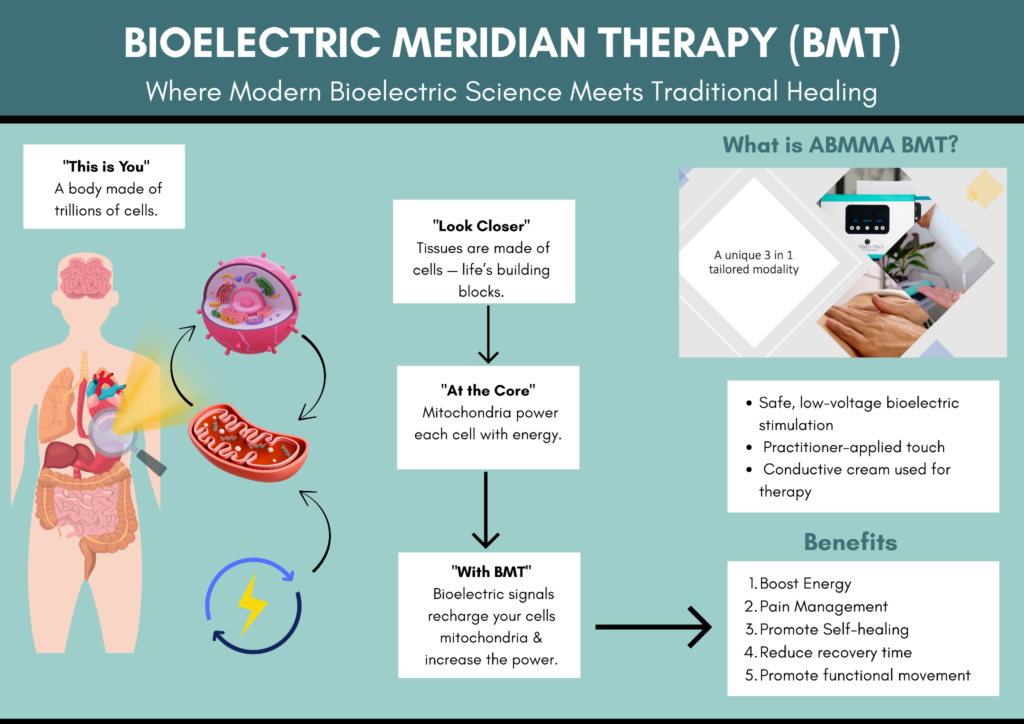
To understand Bioelectric Meridian Therapy properly, it helps to first understand a fundamental principle:
The human body relies extensively on electrical signalling within nerves and muscles as part of its normal physiological function.
Electrical signalling within nerves and muscles is fundamental to movement, sensation, heartbeat regulation, and many aspects of organ function, working together with biochemical and mechanical processes.
Your nervous system continuously transmits electrical impulses between:
- The brain
- Spinal cord
- Peripheral nerves
- Muscles
- Connective tissues
When you lift your arm, turn your neck, or maintain posture while sitting, electrical signals coordinate these actions in real time.
Muscles themselves also rely on electrical activity. Even at rest, muscles maintain baseline electrical tone. Injury, stress, inflammation, poor posture, repetitive strain, or chronic tension may alter these signalling patterns.
This is one reason why bioelectric therapies have attracted increasing clinical interest.
Where Meridian Theory Fits In
Traditional meridian theory originates from East Asian medicine and describes interconnected pathways believed to influence physiological balance and bodily function.
Modern Bioelectric Meridian Therapy does not simply replicate traditional acupuncture concepts. Instead, many practitioners integrate meridian mapping with contemporary understanding of:
- Fascial chains
- Neuromuscular pathways
- Trigger point referral patterns
- Connective tissue networks
- Peripheral nerve distributions
Some researchers have explored possible relationships between traditional meridian pathways and fascial planes, connective tissue networks, or neurovascular structures. Still, these associations remain an area of ongoing investigation rather than an established scientific consensus.
While research in this area continues to evolve, many practitioners use meridian concepts as part of a broader framework for understanding movement dysfunction and systemic tension patterns.
Why Patients Seek Bioelectric Meridian Therapy
Patients rarely seek treatment solely because of pain.
More commonly, they seek help because discomfort begins interfering with function and quality of life.
Examples include:
- Office workers unable to sit comfortably for long periods
- Athletes struggling with recurring muscular tightness
- Older adults experiencing reduced mobility
- Individuals recovering from repetitive strain injuries
- Patients with chronic neck and shoulder tension from prolonged device use
- People whose symptoms persist despite stretching or massage
In many cases, symptoms are not caused by a single isolated issue.
Instead, practitioners often identify combinations of:
- Muscular imbalance
- Restricted mobility
- Poor movement mechanics
- Chronic stress responses
- Postural adaptations
- Reduced physical activity
- Neuromuscular overactivity
This complexity is why personalised assessment is such an important part of treatment.
What Actually Happens During a Session?
Step 1: The Initial Consultation — More Important Than Most Patients Realise
One of the biggest misconceptions about Bioelectric Meridian Therapy is that treatment simply involves attaching electrodes to painful areas.
In reality, the consultation phase is often one of the most clinically important parts of the session.
A skilled practitioner is not merely identifying where symptoms occur.
They are trying to understand:
- Why symptoms developed
- What perpetuates them
- Which systems may be involved
- Whether compensatory movement patterns exist
- How lifestyle factors contribute
Detailed History Taking
The practitioner may ask questions such as:
- When did symptoms begin?
- What activities aggravate them?
- Are symptoms worse in the morning or evening?
- Is there associated numbness or weakness?
- How physically active are you?
- What does your work environment look like?
- How is your sleep quality?
- Have previous treatments helped?
These questions help differentiate between:
- Acute strain
- Chronic overload
- Neurological involvement
- Postural dysfunction
- Stress-related muscular tension
- Movement compensation patterns
Why This Matters
Two patients may both complain of shoulder pain, yet require completely different treatment approaches.
For example:
Patient A:
May have local muscular tightness from overtraining.
Patient B:
May actually have restricted thoracic mobility causing compensatory shoulder strain.
Treating only the painful area without understanding the underlying mechanics may provide temporary relief but fail to address the broader dysfunction.
Step 2: Physical Assessment and Movement Analysis
This stage is often far more sophisticated than patients expect.
The practitioner may assess:
- Joint mobility
- Muscle tension
- Postural alignment
- Functional movement patterns
- Range of motion
- Muscle activation patterns
- Symmetry between body regions
Why Movement Assessment Matters
Pain is not always located where dysfunction originates.
For example:
- Lower back discomfort may stem from restricted hip mobility
- Neck tension may relate to thoracic stiffness
- Knee strain may involve ankle instability
- Shoulder tightness may reflect scapular dysfunction
This interconnectedness is central to many modern rehabilitation approaches and aligns closely with the holistic philosophy behind Bioelectric Meridian Therapy.
Step 3: Identifying Treatment Targets
Once assessment findings are gathered, the practitioner determines which areas to prioritise.
Importantly, treatment targets may include:
- Symptomatic regions
- Compensatory muscles
- Fascial tension lines
- Neuromuscular trigger points
- Meridian-associated pathways
- Supporting stabilising muscles
Why Practitioners Sometimes Avoid the Painful Area Initially
This surprises many patients.
Sometimes directly treating an inflamed or hypersensitive area too aggressively may worsen irritation.
Instead, practitioners may first focus on:
- Reducing surrounding muscular guarding
- Supporting local tissue perfusion and movement
- Restoring movement in adjacent regions
- Modulating nervous system sensitivity
This reflects a broader rehabilitation principle:
the body functions as an integrated system rather than isolated parts.
Step 4: Preparing for Treatment
Patients are usually positioned comfortably on a treatment table or chair.
The environment is intentionally calm because nervous system state matters significantly during therapy.
Why Relaxation Matters Physiologically
When the body remains in a heightened stress state:
- Muscles maintain increased tension
- Breathing patterns become shallow
- Pain sensitivity may increase
- Recovery processes may become less efficient
Creating a relaxed treatment environment may encourage relaxation and may be associated with parasympathetic responses.
Step 5: Application of Bioelectric Stimulation — What Is Actually Happening?

This is the core therapeutic phase.
Specialised devices deliver controlled electrical stimulation to targeted tissues.
However, the goal is not simply to “shock” muscles into relaxing.
The mechanisms are more nuanced.
How Bioelectric Stimulation May Influence the Body
1. Neuromuscular Modulation
Muscles communicate through electrical impulses.
Bioelectric stimulation may influence abnormal muscular firing patterns associated with chronic tension or guarding.
This may help encourage:
- Muscle relaxation
- Improved activation patterns
- Reduced protective over-contraction
2. Sensory Nervous System Effects
Electrical stimulation may also interact with sensory nerve pathways involved in pain perception.
Some theories suggest stimulation may influence how pain signals are processed within the nervous system.
This is related to broader neuromodulation principles used in various rehabilitation settings.
3. Circulatory Support
Muscular contractions generated during treatment may help support local circulation.
Improved circulation may assist with:
- Oxygen delivery
- Nutrient transport
- Metabolic waste removal
This may partly explain why some patients report feelings of warmth or looseness after treatment.
4. Fascial and Connective Tissue Effects
Modern rehabilitation increasingly recognises the importance of fascia — the connective tissue network surrounding muscles and organs.
Restricted fascial mobility may contribute to stiffness and altered movement mechanics.
Some practitioners believe bioelectric stimulation may contribute to perceived improvements in tissue mobility and movement quality, although the underlying mechanisms remain under investigation.
What Does the Treatment Feel Like?
Patients commonly describe sensations such as:
- Gentle pulsing
- Rhythmic tapping
- Tingling
- Mild contractions
- Warmth
- Deep muscular release
Importantly, intensity is adjusted individually.
A common misconception is that stronger stimulation equals better results.
In reality, excessive intensity may provoke guarding responses or discomfort.
Experienced practitioners aim for therapeutic effectiveness while maintaining patient comfort.
Step 6: Real-Time Monitoring and Adjustment
Professional Bioelectric Meridian Therapy is highly dynamic.
Practitioners continuously observe:
- Tissue response
- Muscle relaxation
- Patient comfort
- Movement changes
- Sensitivity levels
Treatment parameters may be adjusted throughout the session.
This adaptability is important because the body’s response can change rapidly during therapy.
For example:
- Muscles may relax progressively
- Previously restricted movement may improve
- Sensitive areas may become less reactive
Step 7: Reassessment After Treatment
One hallmark of evidence-informed rehabilitation is reassessment.
After treatment, practitioners often repeat movement tests performed earlier.
This helps evaluate:
- Changes in mobility
- Reduction in muscular guarding
- Functional improvements
- Symptom response
Why Reassessment Matters
Without reassessment, treatment becomes guesswork.
Objective comparison helps determine:
- Whether the intervention was effective
- Which tissues responded best
- What future sessions should prioritise
Why Patients Sometimes Feel Different After Treatment
Post-treatment responses vary considerably.
Some patients feel:
- Looser
- Lighter
- More mobile
- Relaxed
Others may experience temporary soreness or fatigue.
Why Temporary Soreness Can Occur
Some individuals may experience temporary soreness or fatigue after treatment, potentially related to muscle activation or changes in movement patterns.
This is somewhat similar to how muscles may feel after unfamiliar exercise.
However, severe or prolonged discomfort should always be discussed with the practitioner.
Why One Session Is Rarely the Entire Solution
Many chronic musculoskeletal issues develop over months or years.
Examples include:
- Prolonged desk posture
- Repetitive strain
- Chronic stress tension
- Movement compensation patterns
- Physical deconditioning
Because these patterns develop gradually, meaningful functional improvement often requires:
- Multiple sessions
- Movement retraining
- Strengthening
- Ergonomic changes
- Lifestyle modifications
Bioelectric Meridian Therapy may be most beneficial when integrated into a broader recovery strategy rather than viewed as a standalone “quick fix.”
The Importance of Personalisation
One of the defining features of quality care is individualisation.
No two patients present identically.
Factors influencing treatment include:
- Age
- Activity level
- Occupation
- Injury history
- Stress levels
- Sleep quality
- Physical conditioning
- Existing medical conditions
This is why treatment protocols should never be entirely generic.
How Bioelectric Meridian Therapy in Singapore Fits Into Modern Healthcare
In Singapore, healthcare consumers are increasingly seeking integrative approaches that combine:
- Evidence-informed rehabilitation
- Preventive care
- Functional recovery
- Non-invasive therapies
- Lifestyle optimisation
Bioelectric Meridian Therapy is often explored within this broader context.
Rather than replacing conventional medicine, it may complement:
- Physiotherapy
- Exercise rehabilitation
- Orthopaedic care
- Sports recovery programmes
- Wellness strategies
The emphasis is increasingly shifting from symptom suppression alone toward improving long-term movement quality and physical resilience.
How Kaizen Medical Approaches Patient Care
At Kaizen Medical, treatment begins with understanding the patient as a whole rather than focusing narrowly on isolated symptoms.
The clinical approach emphasises:
- Comprehensive assessment
- Functional movement evaluation
- Personalised treatment planning
- Ongoing reassessment
- Patient education
This allows treatment strategies to be tailored according to each individual’s:
- Lifestyle demands
- Physical goals
- Recovery priorities
- Functional limitations
The objective is not simply temporary symptom relief, but supporting sustainable improvements in comfort, mobility, and overall quality of life.
Conclusion
A Bioelectric Meridian Therapy session involves far more than simply applying electrical stimulation to painful areas.
Behind each stage of treatment lies a detailed clinical process involving assessment, movement analysis, neuromuscular evaluation, tissue response monitoring, and personalised therapeutic planning.
Understanding this deeper process helps explain why Bioelectric Meridian Therapy is increasingly explored not merely as a relaxation treatment, but as part of a broader functional recovery and wellness strategy.
For individuals considering Bioelectric Meridian Therapy in Singapore, knowing what actually happens during a session can help reduce uncertainty and support more informed healthcare decisions.
At Kaizen Medical, the focus remains on evidence-informed, patient-centred care designed around each individual’s unique needs, movement patterns, and recovery goals.
Frequently Asked Questions
1. Is Bioelectric Meridian Therapy scientifically proven?
Research into bioelectric stimulation therapies continues to evolve. Various forms of electrical stimulation are already widely used in rehabilitation and physiotherapy settings. However, outcomes vary depending on the condition being treated, treatment protocols, and individual patient factors.
2. Why do practitioners sometimes treat areas away from the pain?
Pain may originate from compensatory movement patterns or dysfunction elsewhere in the body. Treating supporting muscles, fascial chains, or related movement regions may help address contributing factors rather than focusing only on symptoms.
3. Can Bioelectric Meridian Therapy help chronic tension caused by stress?
Chronic stress may contribute to persistent muscular guarding and altered nervous system regulation. Some patients report relaxation and reduced muscular tension following treatment, although responses vary individually.
4. Why might I feel tired after treatment?
Therapy may influence nervous system activity and muscular tension patterns. Some individuals experience temporary fatigue or deep relaxation afterward, particularly if chronic tension has been present for a long time.
5. Is stronger electrical stimulation better?
Not necessarily. Excessive intensity may increase discomfort or muscular guarding. Effective treatment focuses on achieving appropriate therapeutic response while maintaining patient comfort.
6. How quickly do patients notice results?
Some individuals notice immediate changes in mobility or muscular tension, while others experience gradual improvement over multiple sessions. Chronic conditions often require longer-term management strategies.
7. Can Bioelectric Meridian Therapy replace exercise or physiotherapy?
Generally, no. Bioelectric Meridian Therapy is often most effective when integrated with movement rehabilitation, strengthening, mobility work, and broader lifestyle interventions.
8. Are there people who should avoid this therapy?
Suitability depends on individual circumstances. People with implanted electronic devices (such as pacemakers or implantable defibrillators), certain neurological conditions, active infections or open wounds in the treatment area, or other relevant medical considerations should undergo professional assessment before receiving electrical stimulation-based therapy.
9. Why is posture discussed so much during assessment?
Posture influences muscular loading, joint mechanics, and movement efficiency. Prolonged poor posture may contribute to chronic strain patterns and recurring discomfort.
10. What makes personalised treatment important?
Every patient has different movement patterns, physical demands, health histories, and recovery goals. Personalised treatment helps ensure therapy is tailored appropriately rather than relying on generic protocols.